DRG-AI by Fox Apps
DRG-AI reads the discharge summary, proposes the DRG group, principal and secondary diagnoses and procedures, and shows the exact catalogue page behind every code. Your coders review and confirm instead of searching.
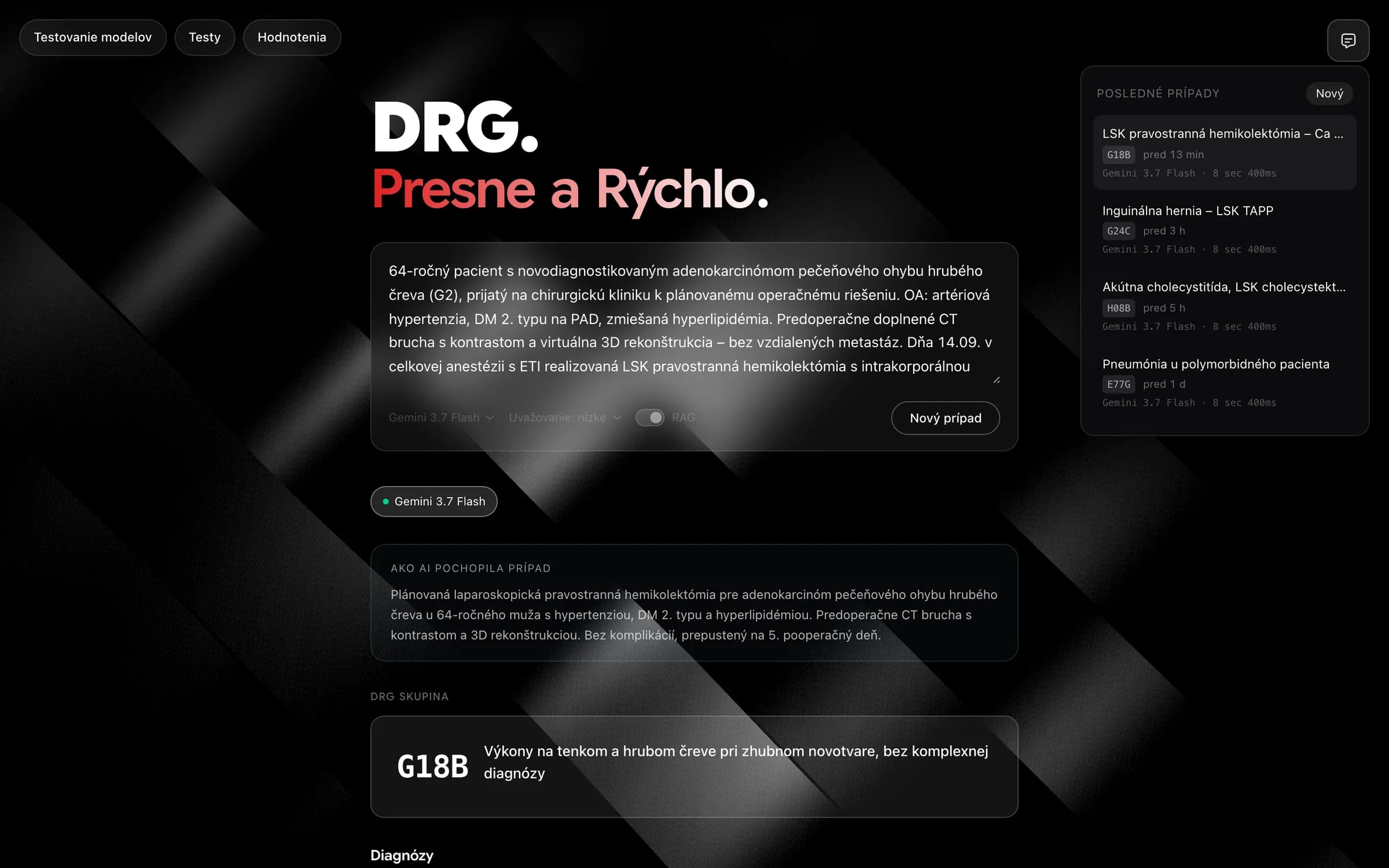
Real product UI. Demo case with fictional patient data.
Why hospitals need help with DRG coding
Thousands of codes, updated every year
Diagnoses, procedures, materials and grouping rules change with each catalogue release. Keeping every coder up to date is hard.
Discharge summaries are written for doctors
Abbreviations, shorthand and scanned pages have to be translated into catalogue terms before anything can be coded.
Mistakes cost money
A missed secondary diagnosis or a nonspecific code changes the DRG group — and with it the reimbursement or the result of an audit.
How DRG-AI works
Paste or upload the case
Discharge summary, operative report or a photo of a scanned page. Text is extracted with OCR tuned for Slovak and Czech.
The AI restates the case
Abbreviations are expanded and the case is summarised in plain Slovak, so a misunderstanding is visible before any code is.
Search the official sources
Hybrid search over MKCH-10-SK, the list of procedures, the case-mix catalogue and coding rules — synced from your document folder.
Proposal with citations
DRG group with relative weight, principal and secondary diagnoses and procedures. Each code links to the passage and page it came from.
Automatic audit
Rule-based checks flag duplicate codes, nonspecific codes, procedures without a supporting diagnosis and missing intensive-care data.
The coder decides
Accept, correct or reject. Feedback is stored and used to measure and improve the system over time.
Built for the coding department
Evidence on click
Click a citation to see the source passage, document and page. Hover a diagnosis to highlight the sentence in the summary that supports it.
Measured, not guessed
An evaluation suite scores the system against cases already coded by the hospital — diagnoses, procedures and add-ons separately.
Your data, your infrastructure
Deployable on-premise or in your private cloud. AI requests can be restricted to EU-based providers.
Model comparison
Run the same case through several AI models side by side and pick the one with the best accuracy for the cost.
Always up to date
Drop a new catalogue into the shared folder; DRG-AI re-indexes only what changed.
Exports
Download cases with their coding and feedback as JSON or CSV for audits and reporting.
Inside the workspace
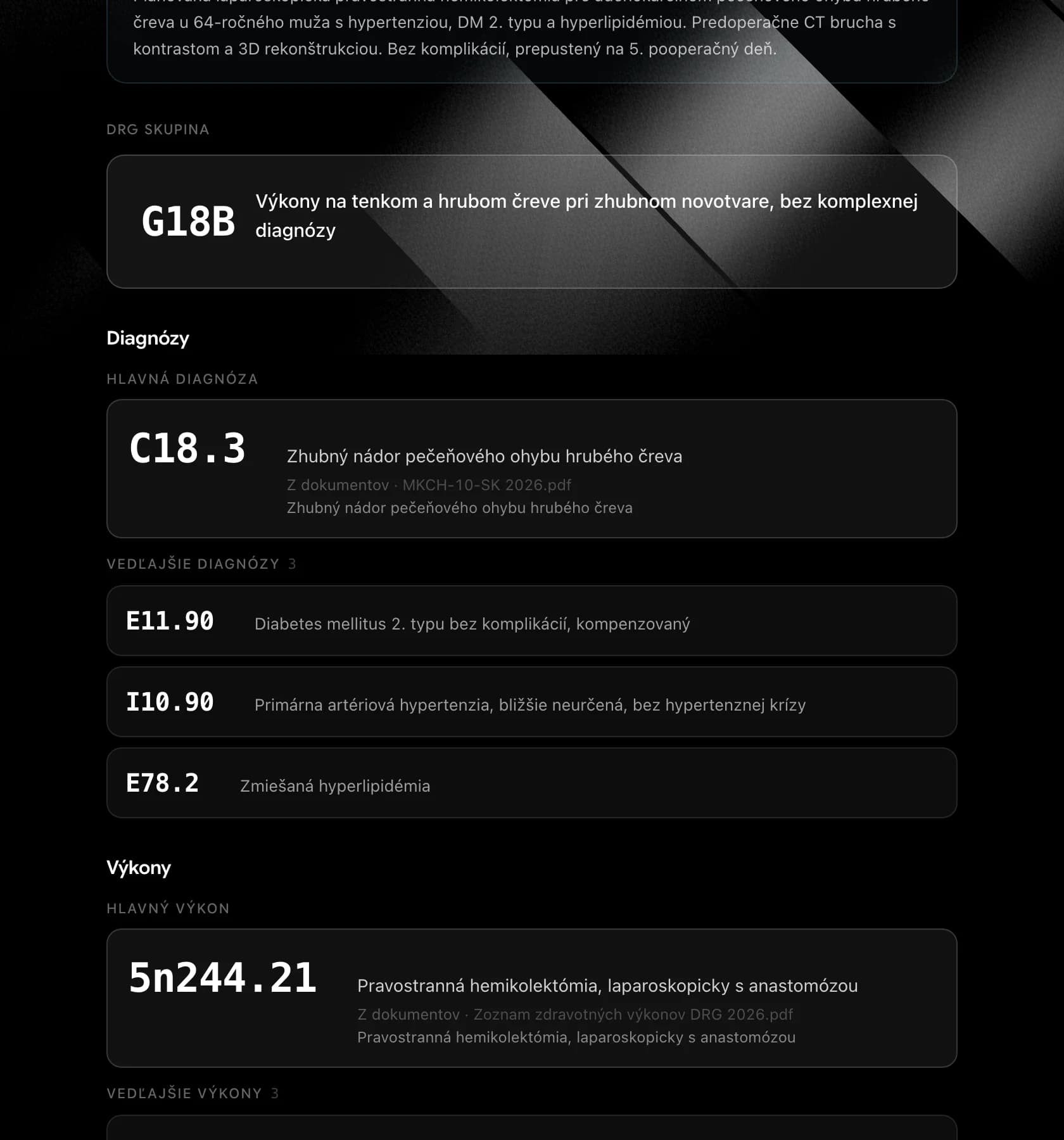
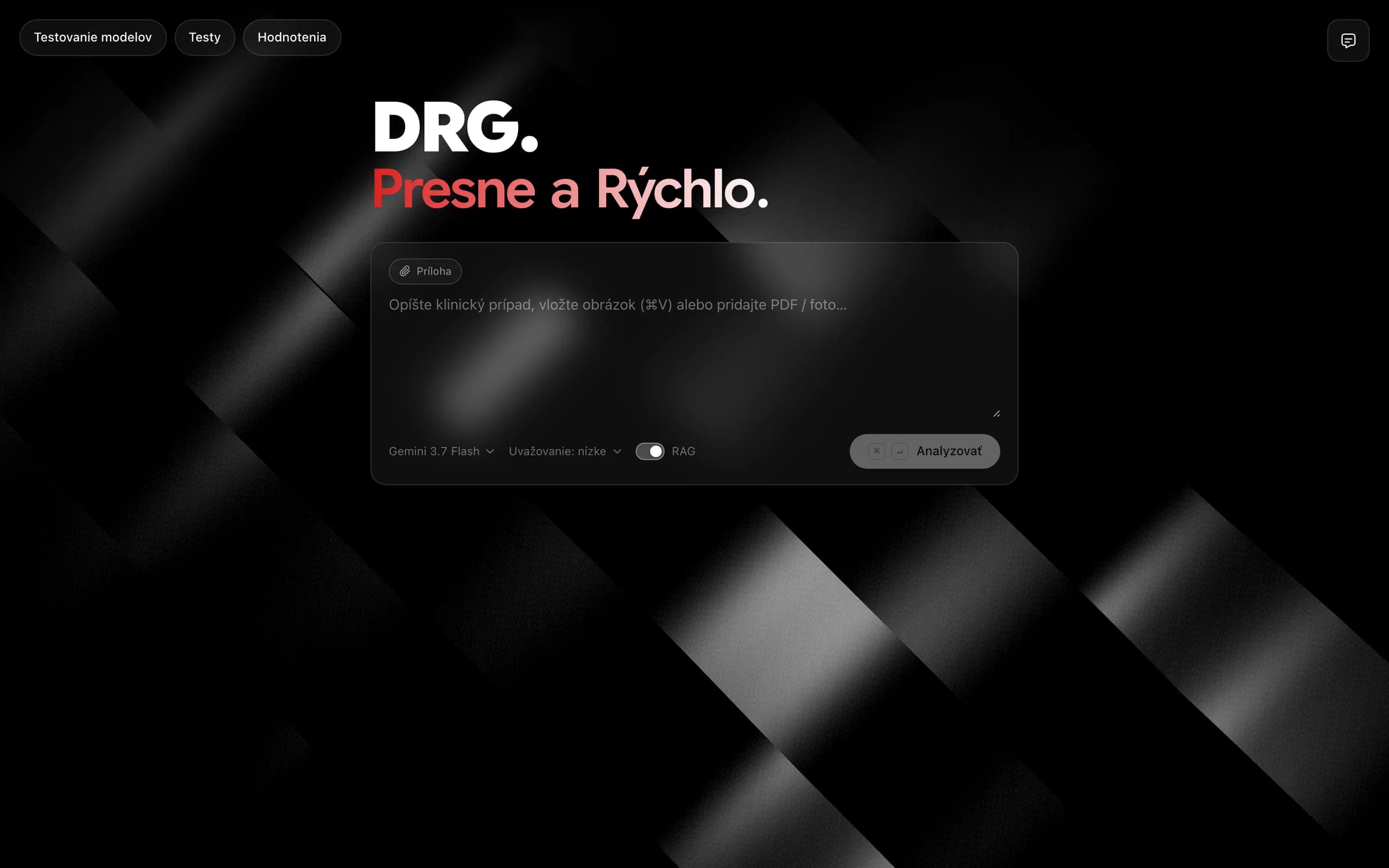
Real product UI. Demo case with fictional patient data.
DRG-AI questions
DRG-AI is also one of our case studies. Read case study
What is DRG and why does coding matter?
DRG (diagnosis-related groups) is the system Slovak health insurers use to reimburse hospital stays. Each case is assigned to a group based on its diagnoses and procedures, so the accuracy of coding directly affects how the hospital is paid.
Does DRG-AI replace the coder?
No. DRG-AI prepares a proposal with sources and warnings; a qualified coder reviews it and makes the final decision. The goal is less searching and fewer missed codes.
Which documents can it read?
Typed text, PDF files and photos or scans of documents. Scanned pages are processed with OCR for Slovak and Czech.
Where is patient data processed?
DRG-AI can run in the hospital’s own infrastructure or private cloud, and AI requests can be restricted to providers located in the EU. We agree the setup with your IT and data protection officer.
Contact
See DRG-AI on your own cases
We will show you DRG-AI on anonymised cases from your hospital and discuss how a pilot could work.
Or email us at info@foxapps.tech